Pull up Gahanna's housing market on two different trackers this summer and you'll get two different stories. One shows the average home value up 2.5% over the past year, with homes going to pending in about four days. The other, looking at the three-month window ending in May 2026, shows the median sale price down 1.6% year over year to $390,000, with homes taking 37 days to sell compared to 36 the year before.
Same city. Overlapping timeframes. Opposite headlines.
Neither number is wrong. They're measuring two different Gahannas, because there isn't one Gahanna housing market. There are at least four, and they move at different speeds and sometimes in different directions. If you're comparing this suburb to others in the northeast Columbus corridor, the citywide median is the least useful number you can anchor to. Here's what's actually happening underneath it.
Four Markets Inside One ZIP Code
Gahanna's housing stock spans a wider range than most Columbus suburbs its size, and each segment has its own buyer pool, its own pace, and its own price ceiling.
| Submarket | Typical housing | Price range |
|---|---|---|
| Creekside District | Condos and townhomes | $200,000 – $310,000 |
| Citywide older sections | Mid-century ranches | $280,000 – $400,000 |
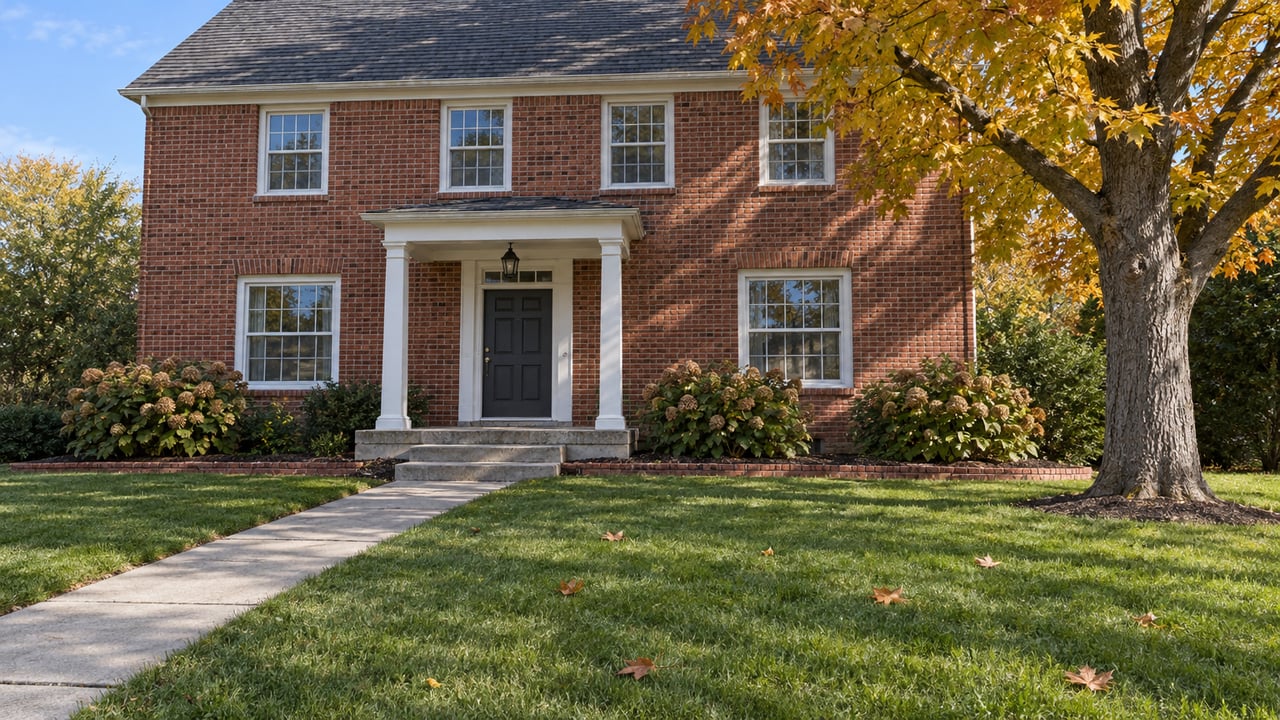
| Pipers Glen, Hamilton Road corridor | 1980s–2000s colonials | $380,000 – $550,000 |
| Premium lots citywide | Executive homes | $500,000 – $900,000+ |
Olde Gahanna, the historic village core near Granville Road, adds another distinct flavor: early-1900s character homes that trade on charm and walkability rather than square footage. Rocky Fork, tucked along the creek of the same name, pulls a different buyer again, one who wants a wooded lot over a walkable downtown.
A buyer with a $350,000 budget and a buyer with a $650,000 budget are not competing in the same market, even though both are technically shopping in Gahanna. They're not even reading the same comps.
Why the Median Can Fall While Prices Rise
This is the part that trips people up. If the median sale price can drop 1.6% while a value index for the same city rises 2.5%, the mechanism isn't decline. It's mix.
A median only tells you the midpoint of whatever homes actually closed in a given window. If a stretch of Creekside condos and starter ranches happens to close in the same three months as fewer executive-home sales, the median shifts down even if every individual home held or gained value. Zillow's index works differently. It smooths across the broader housing stock rather than reacting to which price tier happened to transact that quarter, which is part of why it can show appreciation at the same moment a median sale price looks soft.
The days-on-market data backs this up rather than contradicting it. Homes sold in 37 days on average in that same three-month window, one day slower than the prior year, while 115 homes changed hands in May 2026 compared to 112 in May 2025. More transactions, slightly longer timelines, a median that dipped. That's a market absorbing a different blend of inventory, not a market cooling.
The Creekside Wildcard
There's a second reason to be careful about treating Gahanna as one number right now, and it's construction equipment, not spreadsheets.
On November 17, 2025, Gahanna City Council voted 6-1 to approve a development agreement with Connect Real Estate and Benson Capital for a roughly $100 million overhaul of the Creekside District. Councilmember Nancy McGregor cast the lone dissenting vote, citing concerns about the loss of existing parking. The plan calls for a seven-story building on one side of Mill Street and a six-story building on the other, together holding 263 apartments, a boutique hotel, two restaurants, and coworking space. A second phase would add 24 townhomes, each with first-floor parking and a private patio, on what's currently a city-owned parking lot near Town and Walnut streets.
That project stopped being a rendering this summer. As of July 22, 2026, five long-vacant buildings along Mill Street have been demolished, cleared with help from a brownfield remediation grant, to open up the riverfront parcels the project needs. On the public side, the city's own Creekside Reimagined plan targets fall 2026 for flood mitigation work around the plaza and parking garage, funded through existing city resources rather than a new levy.
In a report by Yahoo News, Gahanna's Director of Economic Development, Jeff Gottke, said: "Creekside is the crown jewel of Gahanna." The approved agreement calls for phase one to reach substantial completion within three years of final approvals.
For the entry-level condo and townhome segment specifically, that means a stretch of construction-adjacent living before the amenity payoff arrives. History with comparable mixed-use overhauls suggests two things happen at once during a buildout like this: nearby resale activity can slow as buyers wait to see the finished product, while long-term value expectations climb because 263 new residents and a hotel's worth of visitors are about to show up on the same three blocks. Anyone shopping the Creekside price band over the next year is buying into that in-between period, not the finished district in the renderings.
Reading the Right Number for Your Budget
If you're comparing Gahanna to Westerville, New Albany, or anywhere else in the corridor, skip the citywide median and ask which of the four submarkets your number actually falls into. A $290,000 budget puts you in Creekside condo territory or an older ranch, competing against buyers who prioritize walkability and a fast close. A $450,000 budget puts you in Pipers Glen or Hamilton Road colonial territory, where 1980s and 2000s construction dominates and inventory turns over more predictably. Above $500,000, you're shopping executive lots, a smaller and slower-moving pool where days on market tend to run longer regardless of what the citywide figure says.
New construction is its own category and a scarce one. Because Gahanna is largely built out, new homes on its edges run $400,000 to $750,000 and don't come up often, so treating a new-construction listing as a comp for an existing colonial down the street will give you a skewed read in either direction.
The Tax Line That Doesn't Show Up in the Listing
One number that doesn't move with any of this is the tax rate, and it's worth running before you fall for a listing price. The primary Gahanna tax district, covering Gahanna-Jefferson Schools and Mifflin Township, carries a property tax rate, so the annual tax bill varies with the home’s assessed value, whether it costs $380,000, $500,000, or $700,000. That tax bill belongs in your monthly payment math from the start, not as a surprise at closing.
Common Questions
Does the Creekside redevelopment affect homes already for sale in the district right now? It will for a while before it helps. Phase one construction on the Mill Street buildings is expected to run for up to three years after final approvals, so buyers and owners in that immediate footprint should plan around a construction-adjacent stretch before the new apartments, hotel, and restaurants are open and drawing foot traffic.
Why do different sites show different price trends for the same month? They're measuring different things. A median sale price reacts to whichever homes actually closed in a given window, so a run of condo sales can pull the number down even while individual home values hold steady. A value index smooths across the full housing stock instead, which is why the two can point in opposite directions in the same season without either being inaccurate.
If you're weighing Gahanna against another Franklin County suburb, the median on a portal is the beginning of the conversation, not the end of it. Michelle Balzer works this market submarket by submarket, from Creekside's construction timeline to Pipers Glen's resale patterns, and can walk you through what your specific budget actually buys before you write an offer. Schedule a personal market consultation to get the numbers that apply to your search, not the citywide average.
This article is general information, not legal, tax or financial advice. Consult a qualified professional about your situation.